

Events
2026
JE — "Colors and Textiles: Dialogues"
— December 4–5, 2026, Auditorium, Palais des Beaux-Arts de Lille, 18 bis Rue de Valmy, Lille
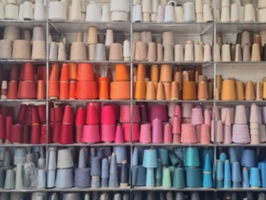
Organized by AFET (French Association for the Study of Textiles)
Click this link to access the program (PDF, 171 KB)
Symposium — "In Situ–On Site. Industrial Heritage and the Geographies of Fashion Production"
— 23–24 November 2026, Central Museum of Textiles / Centralne Muzeum Włókiennictwa, Piotrkowska 282, 93-034 Łódź, Poland

Organised by EFHA–European Fashion Heritage Association
The study of fashion heritage has long centred on the object. This year the EFHA conference turns to the site: the factories, workshops, districts, warehouses and landscapes where fashion and textiles were made, and where the material traces of that production still shape cultural, economic and urban life. Across four panels, speakers from across Europe consider production districts and craft, industrial archives and sample books, oral history and post-industrial memory, and the curating and repurposing of industrial spaces. The venue is part of the argument: the Central Museum of Textiles in Łódź occupies the Ludwik Geyer's White Factory, a mill complex built between 1835 and 1886 in a city made by textiles, and holds one of the largest textile collections in Europe.
Click on this link to go to the website and download the programme
JE — “Critical Design” event dedicated to analysing the rise of a new far-right fashion and style movement"
— 25–26 September 2026, Eschenbachgasse Exhibition, Academy of Fine Arts, Eschenbachgasse 11, Vienna (Austria)
An international gathering bringing together various figures from the world of activist fashion to analyse the rise of a new far-right fashion and style movement. This event will provide a better understanding of how far-right fashion aesthetics shape communities, articulate and spread hatred on a transnational scale. To counter these hateful styles, the event will feature an exhibition of counter-strategies, a fashion show, workshops, round-table discussions, talks and opportunities to shop for revolutionary looks and styles!
Organised by the research project ‘Fashion and the Far Right: The New Complexity of Style’, this event offers an insight into how far-right fashion aesthetics enable communities to organise themselves and spread hatred on a transnational scale. To challenge these hateful styles, the event brings together an exhibition of counter-strategies, a fashion show, workshops, round-table discussions, talks and shopping opportunities to dress in revolutionary looks and styles!
For more information about our project, visit the NéoFashFarRight website
Follow us on Instagram
Art History Festival — Theme: ‘Fashion’ — Guest Country: ‘Morocco’
— 5–7 June 2026, at the Château de Fontainebleau and the surrounding area
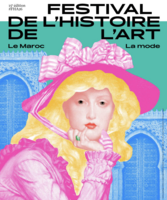
Morocco, Guest Country 2026
To mark its fifteenth edition, the Art History Festival is honouring an African country for the first time: Morocco. Situated at the crossroads of Europe and Africa, with coastlines on both the Mediterranean and the Atlantic, Morocco is distinguished by the richness of its cultural heritage, shaped by a variety of influences — African, Arab, Amazigh and Jewish.
From antiquity to the contemporary scene, the Festival offers an immersive journey through the history of Moroccan art, revealing the diversity of its heritage, the vitality of its traditional craftsmanship and the emergence of new forms of creativity.
Fashion, the theme for 2026
For its 2026 edition, the Art History Festival explores the theme of fashion, viewed as a genuine subject of history, at the crossroads of art, societies and cultures. Far from being confined to the world of luxury or fleeting trends, fashion reveals profound dynamics: the construction of identities, cultural exchanges, and political and economic issues.
From traditional attire to contemporary designs, it bears witness to constant exchanges between eras and regions, whilst fuelling debate and reflection, particularly on issues of cultural appropriation and representation.
For further information, please visit the Festival’s website
2025
Conference — "The economic sociology of fashion"
— April 8, 2025, 2–4 p.m. Room 30 (-1) 20 (Access 30, Level (-1): in the basement), CNAM, 2 rue Conté, Paris 3rd
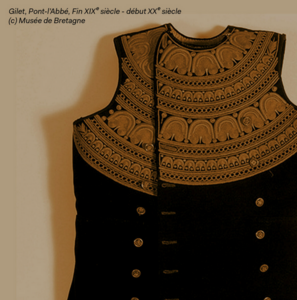
Political philosopher Nathalie Goldwaser Yankelevich (National Scientific and Technical Research Council – CONICET and National University of Avellaneda, Argentina) will discuss (in French) her book, *Fashion, a Fleeting Revolution* (*La moda, revolución efímera*).
The discussion will be moderated by Guillaume Lecoeur (historian and sociologist, PhD from Lise and associate researcher at the HT2S laboratory) who will contextualize the speaker's work based on his own research in economic sociology.
She will present how the phenomenon of fashion has been addressed by the sociological tradition, particularly by the early Frankfurt School.
After offering several definitions of the "phenomenon of fashion" that depart from its usual associations—clothing, ornament, adornment, brands, haute couture houses—she will present a new perspective based on the study of various authors, including Leopardi, Balzac, Baudelaire, Simmel, Freud, Benjamin, Tarde, Frisa, Bard, Berardi, and Fisher, among others. Thus, fashion must be understood as a phenomenon that draws upon tradition, customs, and the immemorial past, appropriating elements of these to introduce novelty which, in the future, will fade and die, becoming a habit or a new custom. Therefore, far from being a simple synonym for clothing, fashion is linked to a relentless repetition at the heart of which revolve death, memory, and oblivion. Everything that covers the body or is perceived by the mind—from architectural or sartorial works to media discourse—is part of this complex phenomenon, which is embedded within the framework of tradition and hegemony. This would answer the question of why we constantly and compulsively buy things, whether objects or services, however trivial and useless they may be. (…)
Seminar — "Clothing and costumes: the constitution of a museum heritage"
— March 26, 2025, 6:15 p.m., Walter Benjamin Room, ground floor of the INHA, Paris
This research seminar is part of the research program "Fashion in Museums: A French History," supported by the Junior Chair in Fashion Heritage at the University of Paris 1 Panthéon-Sorbonne.
Presentation by
Céline Chanas, Chief Curator of Heritage, Director of the Museum of Brittany, "From Costume to Clothing: A History of the Museum of Brittany's Collections. Collections and Acquisitions, Museography and Exhibitions"
She will discuss the history of the clothing collections of the Museum of Brittany, which constitute one of its richest areas of focus. As a museum of society, it is the heir to a long tradition, that of ethnographic museums which have collected and showcased these objects since the late 19th century. From their origins to current perspectives, the seminar will offer an interpretation of these collections through the lens of scholarly and research questions, as well as the narratives and discourses presented to the public.
Presentation by
Françoise David, Head of Research and Exhibitions at the Museon Arlaten – Museum of Provence, will discuss the collection and museography of costume at the Museon Arlaten (19th-20th centuries): a matter of cultural assertion.
She will revisit the creation of the museum within a regionalist context, its central role in the preservation, as well as the codification and reinvention, of traditional costume. This will also be an opportunity to discuss the museum's renovation and the specific scenographic challenges related to Arlesian costume.
2024
JE — "The heritage of medieval and Renaissance embroidery: from inventory to study"
— March 4, 2024 in Paris (INHA, Vasari room and C2RMF, auditorium) and March 5, 2024 in Sens (Museums, Jubé room)
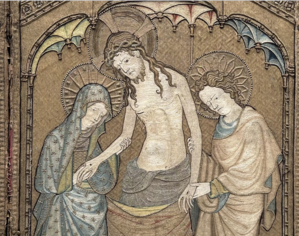
Study Days Embroidered Heritage of the Middle Ages and Renaissance: From Inventory to Study
Registration required by writing to journees.broderiesgmailcom
(Please indicate if you wish to attend the session on March 4, March 5, or both.)
These study days are part of a project to create a digital catalog of embroideries in French collections (1200-1600). Led by the Saprat laboratory (EPHE-PSL) and funded by the City of Paris through the Émergence(s) program, the project brings together a team of researchers supported by the network of French museums, the Inventory of Historic Monuments, and the French National Heritage Service. The aim of this meeting is to bring together embroidery historians from different countries and specialties to take stock of the methods and approaches used to identify, study, and promote this textile heritage, which remains poorly understood and understudied to this day. The program will be presented at this event, along with an overview of the research on the embroideries in the treasury of Sens Cathedral, which fall under the first phase of the investigation.
Click on this link to access the program on the École Pratique des Hautes Études website.
2018
Conference — ‘Iconographies of Clothing and Fashion: Images of Temporality’
— 16 January 2018 DFK Paris, 45 rue des Petits Champs, 75001 Paris
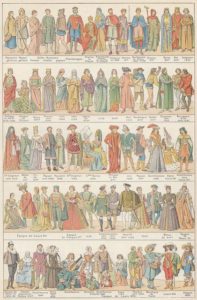
Conference presented by Isabelle Paresys, senior lecturer in cultural history at the University of Lille, IRHiS laboratory.
Her research focuses on clothing and fashion in the modern era, as well as their portrayal in French cinema.
The aim of the lecture is to examine the relationship between ‘fashion images’ and time. Studies of fashion tend to focus primarily on the semiotics of appearances or analyse the aesthetics of their visual representations. However, from a long-term historical perspective, one cannot ignore the role that fashionable clothing plays as markers of temporality in our visual culture. We shall therefore examine the emergence of a specific iconography of clothing from the Renaissance onwards. We shall see how sartorial imagery sought to capture the temporality of fashion—both present and past—by drawing on new editorial genres between the 17th and 19th centuries, until cinema offered an animated retrospective view of fashion in historical or so-called ‘costume’ films.
2012
Entry for the ICOM Prize — “Costume Celebrates Its 60th Anniversary”
— From 18 Apr 14h to 19 Jul 23h
The International Committee of Costume, Fashion and Textile Museums and Collections is celebrating its 60th anniversary.
To mark the occasion, the committee will award a one-off prize.
Proposed projects must meet several criteria. They may cover any topic relating to textile collections: theory, practice, exhibitions, education, research and design.
Furthermore, they must have been in existence for less than three years and be written in one of ICOM’s three languages (English, French and Spanish).
Click on this link for further information on the call for entries (English, PDF, 147KB)
2017
Conference — "Objects and emotions: textile tokens from the London Foundling Hospital, 1740-1770"
— November 30, 2017, 5:30 p.m. Room 830 (8th floor), Olympe de Gouges Building, 8 place Paul Ricoeur, Paris Diderot University, Paris
The nearest metro stations are: Bibliothèque François Mitterrand (Line 14, RER C), Avenue de France (T3).
Room 830 is located on the 8th floor of the building. Access requires a badge, which can be obtained from the reception desk (this badge also allows you to use the elevators).
Lecture by
John Styles (Professor of Modern History at the University of Hertfordshire and former Director of Research at the Victoria and Albert Museum)
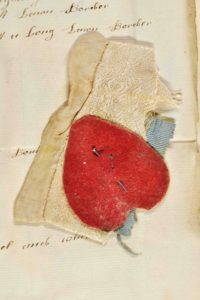
A pioneer in the history of material culture, he specializes in textiles and popular consumption. He is the author of, among other works, *The Dress of the People* (Yale University Press, 2007), and in 2010 he curated the exhibition “Threads of Feeling” at the Foundling Hospital in London. This exhibition focused on the textile tokens left as collateral by mothers forced to leave their children in orphanages, in the hope that this small material token would one day allow them to be recognized and identified as the child's mother.
Session organized by LARCA / UMR 8225 (Traverse Culture Matière)
For further information, please contact Ariane Fennetaux (ariane.fennetauxuniv-paris-diderotfr)
JE — "Textiles for special occasions"
— November 24-25, 2017, Château de Fontainebleau, Fontainebleau (France)
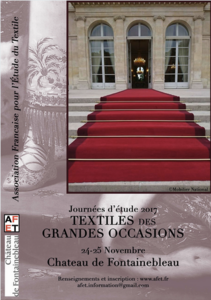
Study Day organized by AFET
Special occasions mark a departure from everyday life. They offer a wide range of individual or collective situations, unique or recurring; they recur in an unchanging form or, conversely, in a renewed one, and can unfold over a longer or shorter period.
Private life, public life, civil or military life, religious life, university life, community life, sports, festive life, cultural life… so many contexts give rise to them.
Textiles, one of the elements associated with this departure, bear the mark of the era, the place, and the social milieu. Carrying an explicit or implicit message, often open to interpretation, they prove to be a valuable tool for understanding a society.
Special occasions alter the intrinsic value of textiles. Whatever their use, whether for clothing or other purposes, they stand out through their material, color, shape, and ornamentation. It can be luxurious, ruinous, or cheap, involve significant expenses or the use of rentals, be new or secondhand, be reused or transformed/adapted, or even be a pastiche.
The areas to explore are very diverse, from "Sunday best" attire to the decorum of sovereigns. The focus will be on identifying the methods and reasons for this unique textile style. Is it the individual's self-perception or the adherence to social codes? Is it ostentation, pretense, or perhaps the individual or group's appreciation of the occasion?
The abstracts must clearly define the proposed communication issue, which must be original. Professional attire is only relevant when worn in exceptional circumstances. Wedding or mourning attire should be avoided…unless the example prompts innovative reflection on the subject.
Click on this link to access the program on the AFET website.
Symposium — "Research in the field of textiles and fashion"
— November 17-18, 2017, 9am–1pm, Terrassa Museum, Terrassa (Catalonia), Spain

This first national symposium bringing together researchers in the field of textiles and fashion is the result of a collaboration between the CDMT (Centre for Textile and Fashion Studies), the Research Group on Textiles and Fashion, and the Fundació Història del Disseny (Foundation for the History of Design). It will feature fifty presentations by speakers from across Spain, including Sílvia Ventosa, curator of the textile and fashion collection at the Museu del Disseny (Museum of Design), who will discuss the textile art collection project at the Museu del Disseny in Barcelona. The opening lecture will be given by Lesley Miller, from the Victoria and Albert Museum and the University of Glasgow.
The symposium aims to be a meeting between universities and museums and an opportunity to share and exchange information on current research projects in textiles and fashion.
Click on this link to download the program (pdf, 837KB)
Seminar —"Anthropology of the Fashion World (AMM)"
— 2017-2018 Program: Thursdays from 10:00 AM to 1:00 PM — *November 16, December 14, 2017, January 11, May 17, from 10:00 AM to 1:00 PM —> CNRS, rue Pouchet, Paris — *June 7, from 2:00 PM to 6:00 PM —> CNRS, rue Pouchet, Paris and Study Day —> *April 6, f
The research seminar “Anthropology of Fashion Worlds” (AMM), launched in October 2015 as part of the activities of the IIAC – LAHIC team and in partnership with the French Ethnological Society (SEF), aims to be a meeting place and forum for exchange, bringing together researchers, students, and professionals interested in fashion, understood here as an economic, creative, technological, professional, social, cultural, and political space, but also as a space for the staging and communication of appearances. A sociological phenomenon, fashion is simultaneously plural, timeless, and non-local, moving back and forth between eras and cultures, while remaining tied to specific territories and traditions.
Given that today, and particularly in France, fashion is most often examined through the lens of the historian, it seems important to revisit the ongoing work devoted to this subject in other disciplines, notably anthropology, ethnology, sociology, and semiology. The aim is therefore to examine the worlds of fashion (and luxury), a reflection of contemporary society and its transformations, from technological (innovative materials, new functions, capabilities given to clothing), economic (changes in supply chains, new positioning of industry and crafts, new consumption patterns), professional (corporations and their rituals, networks, evolution of professions, training, employment, creative processes, production), gendered (masculine, feminine, transgender, unisex practices), communicational (the effect of the Internet, the place given to self-representation and the fashion image), heritage and museum (preservation of knowledge, exhibitions, symbolic productions)...
This year, the seminar will focus on the question of transmission. The worlds of fashion are steeped in history, memory, imagination, and symbolism. The history of fashion is there to remind us of this. However, we wish to move beyond a traditionally historical approach to fashion and adopt an anthropological perspective, considering it as a privileged witness to contemporary practices and social and cultural changes. This year, we propose to study the forms of fashion transmission based on key concepts such as learning, heritage, memory, and preservation. We will attempt to approach this seemingly intangible reality of transmission by examining diverse contexts, environments, and landscapes within which actors and objects—in short, what we call the worlds of fashion—take their place.
Forms of Fashion Transmission (2017-2018 session)
- Session 1 – Learning (November 16, 2017)
- Session 2 – Heritage (December 14, 2017)
- Session 3 – Memories (January 11, 2018)
- Study days in partnership with Parsons, New School – Fashion Displaced (April 6, 2018)
- Session 4 – Conservation (May 17, 2018)
- Session 5 – Discussion about the issue "The Making of Fashion," Terrains/Théories journal (June 7, 2018)
Contacts
- Kristell Blache-Comte, doctorante à l’EHESS ( IIAC, IIAC-LAHIC )
- Anne Monjaret, directrice de recherche au CNRS (TH) ( IIAC, IIAC-LAHIC )
Click on this link to access the program on the EHESS website
Colloquium — "Beyond Paris and London: Influences, Circulation and Rivalries in Fashion and Textiles between France and England, 1700-1914"
— October 13-14, 2017, 9:00 a.m.–4:30 p.m., IHTP/CNRS, rue Pouchet, Paris; Musée Cognacq-Jay, Paris
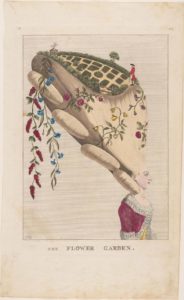
By closely examining the sometimes friendly, sometimes strained relations between France and England through the lens of fashion and textiles between 1700 and 1914, this conference will address several themes, including: the (legal and illegal) circulation of knowledge, people, and objects; the dissemination—and cross-fertilization—of design models between the two countries via the press, engravings, and fashion dolls; the importation of textiles and clothing; the phenomena of copying, espionage, and counterfeiting; and the implementation of protectionist policies aimed at limiting imports from the rival nation.
Particular attention will be paid to the different chronologies of industrialization in both countries in order to better understand innovation and the progressive organization of trades in each. The comparison between the development of the two countries will also consider examples of exchanges between them, such as that of Charles Frederick Worth, the British designer who came to France in 1858 to open a fashion house that quickly became the symbol of haute couture in Paris.
These questions aim to examine the many ways in which fashion and textiles have strengthened or weakened the political, economic, commercial, industrial, and cultural ties between the two countries. The conference also aims to shed new light on the geography of fashion by focusing on capital cities and production centers (Paris-London / Manchester-Rouen / Lyon-Spitalfields), as well as by considering the broader context of a period of intense colonial rivalry between the two countries.
Organized by IHTP-CNRS & LARCA (UMR 8225) – PARIS DIDEROT UNIVERSITY.
This event is part of a series dedicated to cultural exchanges in the field of fashion, which has included
*Haute Couture, Fashion and Consumption, France and England, 1947-1957 (April 11, 2014)
*Franco-American Exchanges in Fashion (April 15, 2016)
*Franco-German Exchanges in Fashion (October 10-12, 2016)
Click on this link to access the program on the GRHAM unit website.
Conference — "History of clothing customs in Europe"
— From October 9, 2017 to May 28, 2018, 7 p.m., ENS, 45 rue d’ULM, Paris
Lecture Series 2017–2018
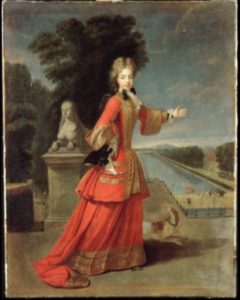
This comparative history of dress norms in different parts of Europe, century by century, will explore the specificities of civilian clothing in the main geo-cultural areas of the European continent, from clothing in Roman Empire to the dominant dress in Europe at the dawn of the 21st century. It will attempt to highlight the characteristics of clothing specific to each era, examine the major transformations that have occurred over time and their causes, the economics of clothing, its modes of diffusion across Europe, and try to understand what clothing tells us about the lifestyles, customs, and values of the societies that wore it.
This series opens the triptych on the cultural history of Europe that the Association of Historians invites you to follow: the history of housing and then the history of food practices will follow.
Click on this link to download the program (pdf, 2.5MB)
Conference — "Transmitting and preserving: the contributions of conservation-restoration to the history of costume"
— October 5, 2017, Museum of Decorative Arts, Paris
With Hélène Renaudin, Assistant Curator of Pre-1800 Collections, Fashion and Textiles
and Emmanuelle Garcin, Conservator, Musée des Arts Décoratifs
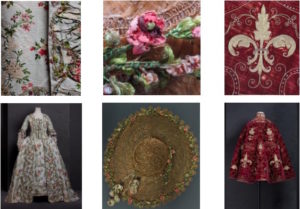
Five pieces of costumes from the Museum of Decorative Arts were restored thanks to the patronage of La Vallée Village in 2017. This operation has made it possible to enrich the knowledge on the collections in a significant way, through the analysis of techniques and materials and the conservation-restoration of the different parts of these outfits.
This conference looks back at three of them (a cape of man from the second half of the 16th century, a French dress from the late 18th century and a hat of women in exotic fibers) and the enrichment of knowledge about the collections that this exceptional restoration allowed.
Click on this link to access the program on the Musée des Arts Décoratifs website.
2016
Workshop — "Textile ornamentation and clothing adornment in museums and historic residences"
— June 9, 2016, University of Wolverhampton, Wolverhampton (United Kingdom)

Frills and Embellishments? Textile Ornamentation and Clothing Adornment in Museums and Historic Homes
Naomi Bailey-Cooper, London College of Fashion, University of the Arts London, How can ornamentation offer an alternative to the decorative and seductive notion of exotic animal materials?
Animal materials such as fur, feathers, and exotic skins are problematic (ethically, socially, and environmentally), yet remain popular as decorative products in contemporary fashion. The industry has developed a whole range of technical imitations of animal fur and exotic skins from other resources. However, few studies explore the seductive and inimitable associations of high-end animal materials and apply these qualities to create alternative ornaments. The historical context of this research lies in the evolution of fur, feathers, and exotic skins from a functional to a decorative use. Drawing on 19th- and early 20th-century archives held at the Victoria and Albert Museum, this research analyzes, through case studies, the rise of the extravagant use of animal materials and the “romanticism of fur.” Examples of these ornaments are preserved at the Victoria and Albert Museum’s Clothworkers Centre in the form of paintings and textural descriptions, as well as period imitations of animal fur.
This research aims to advance textile design practice by using historical archives to identify the key factors that motivated the use of exotic animal materials for decorative purposes. It also aims to apply this knowledge to the design of ornaments using alternative, more ethical, and socially responsible materials and methods. This could encourage other professionals to use museum archives not only as a source of visual inspiration but also for knowledge transfer regarding the motivations and effects of raw material consumption.
Jenni Dixon, University of Birmingham, A Beautiful Ingenuity: Luckcock’s Buttons and 18th-Century Masculine Appearance
The Birmingham Museum houses the James Luckcock Collection, comprising over 500 different buttons, assembled between approximately 1780 and 1820, and considered primarily representative of local Birmingham manufacture. Although buttons were essentially utilitarian, they became highly fashionable accessories for men’s attire in the 18th century, and the Luckcock Collection illustrates the wide variety of designs, materials, and processes used to produce more decorative models. The collection is also unusual because it was assembled at the time of production, or shortly thereafter, which adds another dimension and reveals that these objects possessed desirable qualities beyond contemporary retail and use.
To examine this, I propose to follow the buttons' journey from their use, through retail, to their manufacture in Birmingham (in which Luckcock, as a jeweller, was involved), in order to understand their place as collectibles and to explore ways of identifying with museum objects as they were in the past.
Buttons could be social and cultural markers; some sources comment on the inappropriate choice of buttons, as well as their role in 18th-century masculine appearance and masculinity. While this presentation was aesthetic, these objects also represented the ingenious skills, processes, and technologies that produced them, and which were part of an enlightened manufacturing culture. Birmingham's Soho Manu
To examine this, I propose tracing the buttons' journey from their use, through retail, to their manufacture in Birmingham (in which Luckcock, as a jeweller, participated), in order to understand their place as collectibles and explore ways of identifying with museum objects as they were in the past. Buttons could be social and cultural markers; some sources discuss the inappropriate choice of buttons, as well as their role in 18th-century masculine ostentation and masculinity. Although this ostentation was primarily aesthetic, these objects also reflected the ingenuity of the skills, processes, and technologies that produced them, reflecting an Enlightenment industrial culture. Birmingham’s Soho factory, for example, produced a considerable quantity of buttons, with over half of its site dedicated to button making in the 1780s. Matthew Boulton developed the Soho site as a miniature version of Birmingham, bringing together a variety of trades: from jewelers crafting individual “sparkles” and “cut stars,” to painting, gilding, and edging workshops using various machines. The Soho archives show how a number of Luckcock buttons would have been produced within this division of labor, which was a novelty for consumers and attracted large numbers of tourists both to Soho and the rest of the city. By collecting individual buttons, Luckcock assembled a representative sample of this production, not only as beautiful objects, but also as examples of Birmingham's manufacturing craftsmanship and the processes it entailed. These aspects are obscured in the museum's exhibition, but further research helps to understand their appeal to 18th-century consumers, beyond mere aesthetics.
Anthea Harris, University of Birmingham, “Coptic” Ornamental Textiles in the Ure Museum, Reading
This article reports on the results of a project to critically examine a small collection of so-called “Coptic” textiles, acquired in the 1930s by Annie Ure, the founder of what is now the Ure Museum at the University of Reading, when they were discarded by the British Museum. Described as “trifles of no importance” in Annie Ure’s papers, they were stored unrestored and were only catalogued and examined in the last decade. The collection comprises around 20 objects from a cemetery at Ahkmin in the Egyptian desert, most of which are medallions or ornamental bands detached from linen garments. In some cases, the ornamentation was an integral part of the garment; in others, it was a separate piece sewn onto the finished garment. Almost all the items in the collection were crudely cut from a larger piece of textile (which was then presumably discarded).
Ironically, the criteria on which previous generations of archaeologists, art historians, and museum professionals dismissed these textiles may now be their primary focus. These textiles had suffered a difficult fate before their discovery: most had been damaged by acidic bodily fluids, causing shrinkage or dissolution of the fibers (particularly the wool). At the beginning of the 20th century, collectors and professionals, who had access to an abundance of higher-quality, better-preserved Coptic textiles and were primarily interested in art historical research, dismissed these “inferior” specimens and discarded them, failing to realize that some of them had the potential to provide more information about the “life” of the textile (and thus about the people who interacted with it) than their more “perfect” counterparts.
The objects in the collection I will discuss here illustrate, for example, the ways in which textiles were used, repaired, and reused, as well as the production processes themselves. They show evidence of mending, of ornaments recycled from one garment to another, and of "rags" used as stuffing material in tombs. Most museum collections of late Roman and Byzantine Egyptian textiles do not generally allow for such commentary, although the implications of examining their "social life" from this perspective can be revealing, particularly in challenging historiographies that portray funerary rites as favoring "new" or "the best" garments.
Kate Strasdin, Falmouth University, Forgotten Ephemera: The Hidden Stories of Late 19th-Century Ornaments
Scholars of late 19th-century women’s fashion are well acquainted with the flounces and frills, tassels, trimmings, and passementerie that are integral to the aesthetics of this period. Yet this article argues that these very characteristic ornaments are also, in a sense, invisible: they are forgotten ephemera. In this article, I will examine how to reposition and reinterpret late 19th-century dress ornaments from two perspectives: “embodied” ornaments, which are already an integral part of a garment’s decoration, and “disembodied” ornaments—those pieces that have survived without ever having been incorporated into a garment and which, as a result, arguably retain a different, perhaps more visible, identity.
A recently acquired collection of Edwardian haberdashery items, mounted on their original gauze backings and cardboard, offers researchers a different perspective, allowing them to examine the nature of ornamentation when dissociated from its association with clothing. In this context, these objects become commodities, their price per meter written in pencil in a corner of the cardboard; thus, in my view, these trimmings gain greater visibility. The manufacturers and retailers of these materials have been lost to time, becoming part of the many hidden histories of garment making and textile production. The embellishments on late 19th-century women's dresses are often linked to the history of these objects. This article will examine case studies of the clothing of Queen Alexandra, the subject of my doctoral thesis, in order to analyze how the addition and removal of ornaments evolve over time and according to context: one garment kept in a museum had a beaded fringe added by volunteers in the 1960s to create a more "royal" outfit.
The interpretation of these forgotten ephemeral objects and the highlighting of these aspects of clothing and textile collections, often relegated to the background in favor of more "complete" garments, are part of a growing interest in the many auxiliary trades that have supported the fashion industry but which, until now, have often been neglected.
Anna Sznajder, Bringing Communities Together Through Traveling Collections of Textile Crafts – Bobbin Lace Makers of Central and Eastern Europe
This article aims to introduce the concept of traveling collections of textile crafts through the example of communities and individuals preserving traditional bobbin lace techniques in contemporary Central and Eastern Europe. By examining examples of craft exhibitions such as regional galleries, ethnographic rooms in schools and cultural centers, and private collections, this article seeks to highlight the role of bobbin lace exhibitions as a historical representation of a place's collective craft identity.
Some of these collections are mobile and participate in projects based on cultural exchange with other countries. Current lace exhibitions at fairs across Europe offer a context for interpreting the significance of historical and contemporary crafts in the form of mobile collections. In particular, the Bobowa International Bobbin Lace Festival (southern Poland) provides an insight into the diverse links between craft exhibitions and lacemaking communities at local, national and international levels.
The physical and symbolic space of the exhibition intertwines with local ethnographies and reinforces local identities through interaction with others and with handcrafted objects from the past and present. It also offers insight into the sense of belonging to a broader context created by European artisans. In what ways are these collections innovative? What significance do lace collections acquire within the space of an international event? How do the presentations construct historical meanings for contemporary craft communities, leisure groups, and individuals? This article addresses these questions related to traveling collections of textile crafts by presenting the unique environment of bobbin lacemakers.
Alison Toplis, University of Wolverhampton, Rural Embellishment: Case Studies of Blouse Dresses
By examining in detail a selection of blouse dresses held in local museum collections, this article will focus on the ornamentation and decoration of these garments. These garments will be placed within their local context to explain both why they were made in this way and whether this influenced their inclusion in museum collections.
The focus will be on blouse dresses from different regions of the country, including the south coast of England and Yorkshire, in order to investigate the differences and similarities in both ornamentation and use. In conclusion, this article will consider whether the mere act of collecting blouse dresses in museums in the early 20th century led to an embellishment of the rural past and to misrepresentations regarding the use of the blouse dress.
Mark Wallis, War and Peace
Throughout the modern period, we can observe the emergence of distinct elements of national dress in various European countries, except, curiously, in England. Our national costume—insofar as we can say we had one—is not recognizable as such until the late 18th century. Until then, a (well-to-do) Englishman or woman freely borrowed from the clothing of other nations. The courtesans who thronged around Henry VIII wore French or Italian gowns, while their male counterparts sported outfits in the French or German style—all immediately recognizable to their contemporaries thanks to their differences in cut and decoration. Anything new pleased the king throughout his life, and he owned several "Polish gowns"—one of which is depicted in a portrait of him in his later years.
So-called "Polish" or "Hungarian" clothing was recognizable by its parallel bands of braid decorating the chest and extending from the neck to the waist; these gave the wearer an air of exoticism tinged with a hint of gunpowder, especially since braided "dolmen" jackets were worn by the famous Hungarian hussars and Polish lancers, considered among the best light cavalry in Europe at that time. This decorative style was actually adopted by Christians from the Turks, who conquered Hungary in 1526, although Ottoman turbans were replaced by caps trimmed with fur and feathers – all very elegant!
Elizabeth I was depicted wearing a feminine version of the men's doublet, adorned with bands of braid in the still-fashionable Polish-Hungarian style, while her subjects, as is well known, borrowed from other nations for their clothing, mixing Italian breeches, Dutch capes, German doublets, Spanish shoes, and French hats. Shakespeare mocked this indiscriminate borrowing.
In the 18th century, when these garments in my collection were made, the Polish-Hungarian style was at its height, and men wishing to appear military or mysterious sometimes wore braided coats. Their sons and grandsons in the 19th century did the same, while the light cavalry regiments of all European armies were dressed as hussars, lancers, and dragoons, the former still wearing the braided jacket and fur cap of their 16th-century ancestors. The Royal Horse Artillery of the modern British Army still wears such braided jackets in its dress uniform, so the style endures and, in my opinion, has lost none of its exoticism over the centuries.
Rosamund Weatherall, National Trust Textile Conservation Studio, Study and Revelation: Documenting and Conservation of the Sequined Bed Hangings from Knole House, Sevenoaks, Kent
The sequined bed from Knole House, Kent, the former residence of the Sackville family, is currently undergoing conservation treatment at the National Trust Textile Conservation Studio in Norfolk. It is arguably one of the most important state beds in the country, yet it also remains somewhat enigmatic. The bed is known to have existed in its present form from the early to mid-18th century and to have remained in its current location since its installation. It was not the subject of any major study until Knole launched a major, long-term conservation project, funded by the HLF, for the house and collection, when it was considered a royal possession, like many other pieces in the collection. The work of Emma Slocombe, the project's curator, has begun to reveal something of its true origin: it appears to be a set of textiles commissioned by Lionel Cranfield, 1st Earl of Middlesex, in the early 1620s. This merchant had risen to the rank of Lord High Treasurer to James I in 1621, and his daughter had married a member of the Sackville family. These textiles were intended for a man of high rank. A study of the inventories of Chelsea House, his London residence, reveals a lavishly decorated home and mentions, in particular, a set of state furniture including a state chair, a grand armchair, two four-poster beds and high-backed chairs, as well as a set of stools. Another document, a letter, refers to the bed made for his wife, who is said to have slept “very sumptuously” in furniture made by the king’s craftsmen (Chamberlain, II, Letter 394, 10 November 1621, p. 406; Letter 399, 22 December 1621, p. 417; Town and Fryman, “Lionel Cranfield and the Furnishing of Chelsea House 1620-1625,” p. 4).
Each of these suites shares common features with the textiles found on the current bed: embroidery, fringe, and crimson damask. The existing hangings feature two distinct types of applied embroidery, but with shared motifs. Conservation work has also begun to reveal details hidden beneath a layer of dust and lost to wear. Our current task with the bed hangings is to document our findings, clean the curtains with water, and stabilize the appliqués, which were originally composed of silver and gold fabric, silver and gilt sequins, beads, silver and gold metallic thread cords, silver and gold looped braids, and deep, narrow fringes.
Workshop 5 — "Anthropology of the Fashion Worlds"
— June 8, 2016, 10am-1pm, Room 159, CNRS Pouchet Site, 59-61 rue Pouchet, 75017 Paris
Session 5 – Roundtable: Fashion and Heritage
The workshop “Anthropology of Fashion Worlds” aims to be a meeting place and forum for exchange, bringing together researchers, students, and professionals interested in fashion, understood here as an economic, creative, technological, professional, social, heritage, and political space, but also as a space for the staging and communication of appearances…
Anne Monjaret, ethnologist, sociologist, IIAC-LAHIC, CNRS, EHESS, President of the SEF
Kristell Blache-Comte, anthropologist, IIAC-LAHIC, CNRS, EHESS, photographer
Click on this link to download the program (pdf, 8.2 MB)
Workshop 4 — "Anthropology of the Fashion Worlds"
— May 11, 2016, 10 a.m.–1 p.m., Media Library, Museum of the History of Immigration, 293 avenue Daumesnil, Porte Dorée, Paris
Session 4 – Roundtable: Fashion and Globalization
The workshop “Anthropology of Fashion Worlds” aims to be a meeting place and forum for exchange, bringing together researchers, students, and professionals interested in fashion, understood here as an economic, creative, technological, professional, social, cultural, and political space, but also as a space for the staging and communication of appearances…
Anne Monjaret, ethnologist, sociologist, IIAC-LAHIC, CNRS, EHESS, President of the SEF
Kristell Blache-Comte, anthropologist, IIAC-LAHIC, CNRS, EHESS, photographer
Click on this link to download the program (pdf, 8.2 MB)
JE — "The Staging of Fashion"
— April 13-14, 2016, conference room, Pouchet CNRS site, 59-61 rue Pouchet, Paris

Organized by
*The Interdisciplinary Institute of Contemporary Anthropology, LAHIC – CNRS, EHESS
*Anne Monjaret, ethnologist, sociologist, IIAC-LAHIC, CNRS, EHESS, President of the SEF
*Kristell Blache-Comte, anthropologist, IIAC-LAHIC, CNRS, EHESS, photographer
In partnership with the French Ethnological Society (SEF)
Click on this link to download the program (pdf, 403KB)
JE — "Men's Fashion 1820-1970"
— March 2, 2016, 2-5 p.m., Galerie Colbert, Salle Vasari, National Institute of Art History, 2 rue Vivienne or 6 rue des Petits Champs, Paris
Free admission
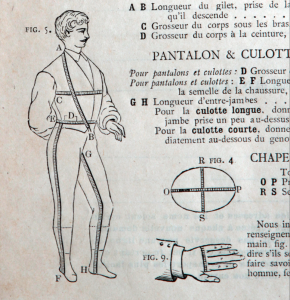
After a first year devoted to research sources, the second year of the seminar "Men's Fashion 1820-1970," organized within the framework of the "History of Fashion and Clothing" program, will focus on bodies and objects, pursuing the same objective: to highlight the singularity and complexity of these 150 years of men's fashion.
Speakers
- Joya Indermühle, Curator, Swiss National Museum, Zurich, The Tie Through Time: Forms, Fabrics, and Motifs
- Elizabeth Semmelhack, Senior Curator, The Bata Shoe Museum, Toronto, Men in Heels: The Politics of Augmented Height
- Raphaël Sagodira, Collector, Paris, The Formal Man Materialized Analysis of selected wardrobe elements from 1910-1930
Audiovisual Archives
- Men’s Fashion, program 24 Hours on Channel 2, February 9, 1970, INA (ORTF)
- Men’s Fashion, 8 PM News, November 28, 1970, INA (ORTF)
Conference — "Fashion & Borders: Identities, Cultures and Territories"
— February 9-10, 2016, Grand Amphitheater, Lumière University Lyon 2, Lyon

Fashion today occupies territories far beyond clothing and physical appearance.
It seems appropriate to examine the fields of fashion and the notion of boundaries within fashion.
Does fashion, which integrates and reduces differences, play the role of a boundary?
In a geographical, economic, or ethical sense?
Where are the limits of fashion defined?
What are the margins of fluctuation for a fashion brand in terms of creativity, production, communication, and use?
The intermediate spaces linked to the notions of gender and identity, which fashion opens up, will also be explored during the conference.
Click on this link to download the program (pdf, 237KB)
Seminars — "Gender and History"
— February–June 2016, Darwin College, University of Cambridge, Cambridge (United Kingdom)

This lecture series for postgraduate students provides a well-established forum for anyone interested in the historical dimensions of gender, sexuality, feminism, and masculinity across a broad chronological period, a wide geographical area, and various disciplines. We welcome speakers from the Cambridge History Department and other faculties, as well as from other universities.
Click on this link to access the program on the University of Cambridge website.
Symposium — "Fashion in Museums: Past, Present and Future"
— April 20-22, 2016, Rijksmuseum, Amsterdam (Netherlands)
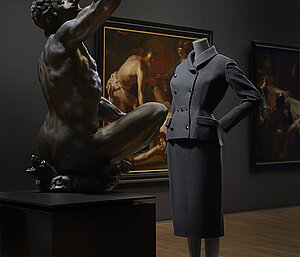
The perspectives of curators and conservators will not be the only ones presented; those of administrators will also be addressed. These administrators, who are often unaware of the specific requirements related to costumes and fashion, will need to be convinced of the high cost of a fashion exhibition. Experts from leading national and international institutions will share their insights: a conference not to be missed.
Over the past two decades, most of the most successful fashion exhibitions worldwide have focused on contemporary designers and have been offered to the institutions involved as a complete package, including the full marketing and publicity apparatus of the fashion brand. This is a far cry from Diana Vreeland's original concept (1983-1984), which involved a museum celebrating a contemporary designer—in her case, Yves Saint Laurent—by presenting a retrospective organized and curated by the museum itself.
In a speech delivered by renowned fashion journalist Suzy Menkes (editor-in-chief of Vogue International) at the Rijksmuseum in June 2015, she called for a return to museum-organized exhibitions based on in-depth research of their own collections, which hold so many surprising yet unexplored treasures. With the exhibition Catwalk. Fashion in the Rijksmuseum (February 20 – May 15, 2016), the museum takes another step in this direction by presenting a representative sample of its costume collection – the oldest in the country – in a setting designed by the celebrated [designer's name missing].
Click on this link to access the program on the Cultures and History of Fashion-Hypotheses website.
2015
Workshop 3 — "Anthropology of the Fashion Worlds"
— January 13, 2015, 10am-1pm, Media Library, Museum of the History of Immigration, 293 avenue Daumesnil, Porte Dorée, Paris
Session 3 – Roundtable: Fashion and Precarity
The workshop “Anthropology of Fashion Worlds” aims to be a meeting place and forum for exchange, bringing together researchers, students, and professionals interested in fashion, understood here as an economic, creative, technological, professional, social, cultural, and political space, but also as a space for the staging and communication of appearances…
Anne Monjaret, ethnologist, sociologist, IIAC-LAHIC, CNRS, EHESS, President of the SEF
Kristell Blache-Comte, anthropologist, IIAC-LAHIC, CNRS, EHESS, photographer
Click on this link to download the program (pdf, 8.2 MB)
Workshop 2 — "Anthropology of the Fashion Worlds"
— December 9, 2015, 10am-1pm, Room 159, CNRS Pouchet Site, 59-61 rue Pouchet, Paris
Session 2 – Roundtable: Fashion, Art, and Creation
The workshop “Anthropology of Fashion Worlds” aims to be a meeting place and forum for exchange, bringing together researchers, students, and professionals interested in fashion, understood here as an economic, creative, technological, professional, social, cultural, and political space, but also as a space for the staging and communication of appearances…
Anne Monjaret, ethnologist, sociologist, IIAC-LAHIC, CNRS, EHESS, President of the SEF
Kristell Blache-Comte, anthropologist, IIAC-LAHIC, CNRS, EHESS, photographer
Click on this link to download the program (pdf, 8.2 MB)
Workshop 1 — "Anthropology of the Fashion World" October 14, 10:00 AM - 1:00 PM Symposium
— October 14, 2015, 10 a.m.–1 p.m., Media Library, Museum of the History of Immigration, 293 Avenue Daumesnil, Porte Dorée, Paris
Session 1 – Discussion Around the Fashion Mix Issue on the theme of Fashion and Migration – with the journal Hommes & Migrations
The “Anthropology of Fashion Worlds” workshop aims to be a meeting place and forum for exchange, bringing together researchers, students, and professionals interested in fashion, understood here as an economic, creative, technological, professional, social, cultural, and political space, but also as a space for the staging and communication of appearances…
Anne Monjaret, ethnologist, sociologist, IIAC-LAHIC, CNRS, EHESS, President of the SEF
Kristell Blache-Comte, anthropologist, IIAC-LAHIC, CNRS, EHESS, photographer
Click on this link to download the program (pdf, 8.2 MB)