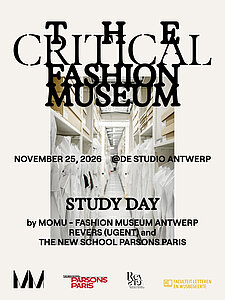
The Critical Fashion Museum is a collaborative research project led by Revers (Ghent University), MoMu – Fashion Museum Antwerp and The New School Parsons Paris. It offers a space for reflection on the idea of a ‘critical’ fashion museum, addressing issues relating to institutional bias, curatorial positioning, academic independence and relations with communities. It aims to foster dialogue between researchers working on academic and curatorial practices and museum professionals. In recent years, fashion museums and exhibitions have become both venues for critical discussion and arenas of contestation. Museum collections, policies and histories have long been shaped by colonial and imperial logics, class privilege, social ‘education’ projects and structural racism. These various factors are now the subject of renewed critical scrutiny. This issue is more pressing than ever, as fashion exhibitions are enjoying growing popularity – even beyond fashion museums – attracting ever-larger audiences and generating considerable interest. At the same time, chronic underfunding and restrictive institutional frameworks have increased museums’ dependence on brands, multinational conglomerates and commercial partnerships. Brands have not only invested in fashion exhibitions and in supporting public institutions, but have also begun to construct their own institutional narratives by establishing their own museums. A new global institutional landscape has thus emerged, making it essential to reflect on the scope of action, accountability and autonomy of museums and curators. In this context, what does it mean to envisage a ‘critical’ fashion museum? How can museums and curators challenge institutional biases and their own positioning? What are the necessary conditions for academic independence? And how might we rethink the relationships between museums and the communities whose histories and material cultures they collect and represent?
The Critical Fashion Museum Symposium The first symposium will take place on 25 November 2026 at De Studio, in Antwerp. It will be organised by Revers (Ghent University), MoMu–Fashion Museum Antwerp and The New School Parsons Paris, with the support of GIS ACORSO. This study day will create a space to explore these issues and foster dialogue between researchers working on academic and curatorial practices and museum professionals. Through these exchanges, The Critical Fashion Museum aims to spark a broader reflection on what a critical approach to the museum and fashion exhibitions might mean today. Contact: reversugentbe
IN2FROCC – International and interdisciplinary network for research on children and clothing
As an important part of children’s material culture, children’s clothing helps to shape their social identity, gender and age, as well as developing their sensitivity and fostering their interactions with their environment. The focus on children’s education and well-being has never been greater, and their voices are being prioritised in shaping an inclusive future. Thus, studying their clothing behaviour provides a better understanding of their capacity for agency. With the recent increase in projects focusing on children’s heritage and material culture, it is essential to gain a deeper understanding of their interactions with clothing.
This group brings together historians, anthropologists, sociologists, ethnologists, museum curators, children’s services professionals, designers, industry representatives and children themselves, as part of a study of children’s clothing across the globe, through time and across social ecosystems. This international and interdisciplinary network aims to engage in current research on dress codes, fashion and children’s clothing in an innovative, inclusive and organic way.
Collaborative research project – “Bespoke women’s clothing (1750–1930)”
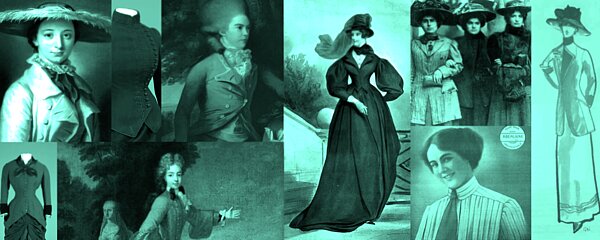
The group comprises 32 international members, including university lecturers, museum professionals and independent historians. The following objectives have been set: “ A comparative study of the material culture, design, manufacture, retail and consumption of made-to-measure clothing for and by women, across all market segments, between 1750 and 1930”. We are examining this issue in the context of the struggle waged by women from all social classes for social, economic and political inclusion between 1750 and 1920. Divided into several small research groups, members are exploring numerous aspects of the broad theme of made-to-measure women’s clothing.