Aude Le Guennec, “Children’s clothes, or a step into history…”
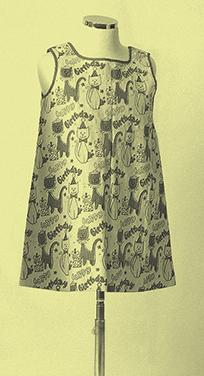
Aude Le Guennec, Children’s Clothing or the Entry into History – A Study from the 18th Century to the Present Day through Western Public and Private Collections
Defended at the University of Paris-Sorbonne on 9 December 2016, this thesis in Art History and Archaeology, supervised by Pierre-Yves Balut, was awarded by a jury chaired by Anne Monjaret (EHESS, LAHIC) and comprising Lou Taylor (University of Brighton) and Régine Sirota (University of Paris-Descartes, CERLIS)
Author’s abstract: Within the broader field of research on clothing, French children’s fashion remains a relatively understudied area. Yet children’s clothing from the 18th century to the present day is abundantly represented in the collections of museums of fashion, ethnology and decorative arts. Drawing on these largely untapped collections and cross-referencing them with archives on clothing manufacture and users’ accounts, this thesis analyses the relationship between children and their clothing. Although children possess the ability to speak, to manipulate objects and to express desires, at birth they are not imbued with the social conventions that underpin our lives in society. A child’s upbringing consists, within a constant relationship of dependence on adults, of socialising the young child to bring them into history. Taking into account the capacity of clothing to shape identities and confer a particular status upon the wearer, our study regards it as an essential tool for socialisation in the hands of adults. At the same time, as a malleable technical system, a source of sensations, and an object of desire and fantasy, clothing is used by children in their own way. In order to move beyond a purely adult perspective, we have sought to deconstruct this process of socialisation by analysing how children appropriate clothing. Thus, when combined with historical, sociological and ethnological data, the study of children’s clothing from French museum collections sheds new light on the history of childhood and demonstrates the contribution of material culture to the sociology of childhood, a source of insight into the workings of our society.
Jérémy Cundekovic, “Reality, Modalities and Visibility of a Fashion Trend …”
Memory
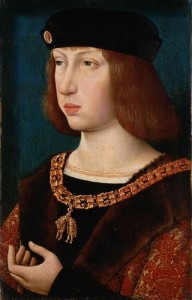
Jérémy Cundekovic, Reality, Practices and Visibility of a Fashion Trend: The Fashion for Black at the Court of the Burgundian Netherlands under Philip the Fair (1496–1506)
Master’s thesis (M1–Research) supervised by Marjorie Meiss-Even (University of Lille, IRHiS laboratory). Defended in June 2015. Available for consultation at the laboratory library.
Author’s abstract: This study examines the fashion for black at the court of the Burgundian Netherlands. Although often discussed, the fashion for black—which appears to have emerged at the court of the Dukes of Burgundy as early as the reign of Philip the Good—is in fact very poorly understood. Frequently cited in historical scholarship as a feature of Burgundian court life, this widely accepted assumption has in fact been based primarily on an empirical analysis of 15th-century Flemish paintings and portraits, which abound with figures from all walks of life dressed in black. This over-representation of black clothing has therefore led historians to conclude that there was a fashion for black at the Burgundian court. However, few studies have analysed this phenomenon using written sources, particularly the Burgundian accounts – which are very comprehensive and well-preserved – and which enable us to measure and observe the court’s consumption of clothing, textiles and colours. Set against the backdrop of the final decade of Philip the Fair’s reign (1496–1506), this study aims first and foremost to test this historiographical hypothesis, examining the extent to which a fashion for black was actually prevalent amongst the Duke’s entourage at the dawn of the 16th century. However, rather than merely examining whether this court did indeed dress in black, this work also seeks to define this phenomenon and understand its characteristics, as well as the issues and limitations surrounding it, both in terms of how it was worn (in terms of time, place, occasion, etc.) and its visibility (materiality, visual quality, colour combinations, etc.), aiming for the most comprehensive analysis possible of Burgundian dress practices. Straddling the fields of material culture, visual culture and court history, this thesis explores issues that seek to situate this fashion—and dress practices in general—within a much broader perspective and context than a mere question of taste.
Pauline Antonini, ‘Costume at the Court of Francis I: Luxury and Pomp in the Renaissance’
Thesis
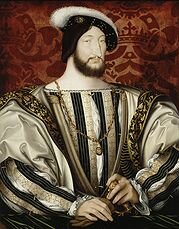
Pauline Antonini,Costume at the Court of François I: Luxury and Pomp in the Renaissance
Thesis from the École nationale des chartes, supervised by Nicolas Le Roux, defended in 2013. The thesis may be consulted at the Centre historique des Archives nationales (Paris); access is subject to the regulations of the École nationale des chartes.
Author’s summary: The long and iconic reign of François I began at the dawn of the 16th century. The victor of Marignan was not merely a man of war: his court was one of the most refined in Europe. The period was indeed marked by the construction of royal castles, the Renaissance of the arts, the influence of Italy, but also by the growing importance of fashion. The king succeeded in establishing a genuine fashion policy that extended beyond the kingdom’s borders. Clothing is a visible marker of the wearer’s rank and wealth, a crucial aspect in the small, image-conscious world of the court. The few accounts that have survived reveal the kilometres of velvet, satin, and gold or silver brocade purchased at astronomical prices for the king or queen. At festivities, the court donned its finest finery, but it was particularly during meetings with foreign sovereigns that this sartorial luxury reached its peak. The Renaissance was, in fact, a period when distinct national fashions emerged at each European court, whilst also influencing one another. Thus, long before the more formal courts of the late 16th and 17th centuries, a ‘court costume’ with its own distinct codes began to take shape.
Johanna Zanon, ‘When Fashion Celebrates the Female Form: Jean Patou (1919–1929)’
Thesis
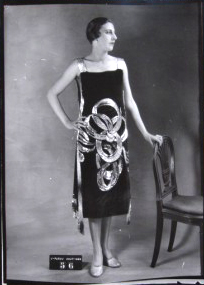
Johanna Zanon, When Fashion Celebrates the Female Form: Jean Patou (1919–1929)
Thesis from the École nationale des Chartes, supervised by Jean-Michel Leniaud, defended in 2012. The thesis may be consulted at the Centre historique des Archives nationales (Paris); access is subject to the regulations of the École nationale des Chartes.
Author’s abstract: Long overshadowed by his famous rival Gabrielle Chanel, Jean Patou is now the subject of renewed scholarly interest. The 1920s were a formative period for his fashion house, as it developed its identity, experimented with innovative organisational and managerial practices, forged its brand image and established its aesthetic principles. The aim of this thesis is to examine his modernity, exploring the tension between discursive construction and actual reality. To this end, the thesis draws on a wide and abundant range of sources, such as photographs taken for industrial design protection purposes, the company’s administrative archives, garments held in museums, and the specialist press. These sources complement one another to provide an overview of the various aspects of the fashion house, illuminated by an interdisciplinary approach drawing on different fields of history and sociology. Jean Patou embodied the perfect blend of entrepreneur and designer. The family business that bears his name operated under a streamlined organisational structure and pursued a strategy of concentration and diversification. His paternalistic approach was aimed at improving his employees’ working conditions. Capitalising on advances in advertising and marketing, the fashion house pursued an aggressive communications strategy. It is not only the brand image thus created that Patou defends by combating counterfeiting, but also his position within the Parisian haute couture scene. Patou’s designer fashion was part of the Art Deco movement and celebrated the female form, in line with the new sporting and leisure activities of the elite. The practices of the House of Patou placed it firmly in the modern era. It established itself as one of the leading fashion houses before being hit by the economic and financial crisis in the early 1930s. Emblematic of the industrialisation of haute couture and the shift in scale within this luxury industry, it helped to make Paris the undisputed capital of fashion until the Second World War. Johanna Zanon is currently a PhD student at the University of Oslo in Norway. Her doctoral thesis explores the phenomenon of the ‘Sleeping Beauties’ through a comparative study of the fashion houses Jean Patou, Elsa Schiaparelli and Madeleine Vionnet from their inception to the present day.